As an Amazon Associate, we earn from qualifying purchases. Some links on this site are affiliate links at no extra cost to you. Our recommendations are based on thorough research and editorial judgment.

Temperature Thresholds for Pest Development

Temperature thresholds heavily influence pest development. For instance, cold-blooded insects, like the alfalfa weevil, won’t grow below 48°F. Above 90°F, their growth halts. That’s where Growing Degree Days (GDD) come in—the heat needed for insects to develop. Each pest has its own GDD requirement. The alfalfa weevil needs about 190 GDD to start feeding. Understanding these thresholds can help you manage pests effectively and avoid gardening mishaps. Stick around for more tips on pest control!
Key Takeaways
- Temperature thresholds dictate when cold-blooded insects can develop, with many unable to grow below specific temperatures, like the alfalfa weevil at 48°F.
- Insect life cycles are accelerated between 50°F and 90°F, requiring regular temperature monitoring for effective pest management.
- Growing Degree Days (GDD) estimate insect pest development based on heat accumulation, using average temperature formulas for accurate tracking.
- Different insect pests have unique GDD requirements, such as the alfalfa weevil needing 190 GDD to begin feeding.
- Understanding temperature thresholds helps optimize pest management strategies and reduces unnecessary pesticide use in gardening.
Importance of Temperature in Insect Development
Understanding the importance of temperature in insect development is essential for any gardener or farmer. Temperature thresholds directly impact insect growth and reproduction. Cold-blooded insects, like the alfalfa weevil, can’t develop below specific temperatures, such as 48°F. Ideal temperatures speed up their life cycles, while high heat, often above 90°F, brings development to a standstill. This knows how significant temperature is for effective pest management. It’s a critical factor in predicting when pests will emerge and become a threat. Natural solutions such as peppermint oil can be effective in managing pests during specific temperature conditions. Remember, seasonal temperature changes affect insect life cycles. Consequently, regular monitoring is necessary to stay ahead of potential issues in your garden. After all, keeping insects at bay is easier when you know their temperature preferences!
Understanding Growing Degree Days (GDD)
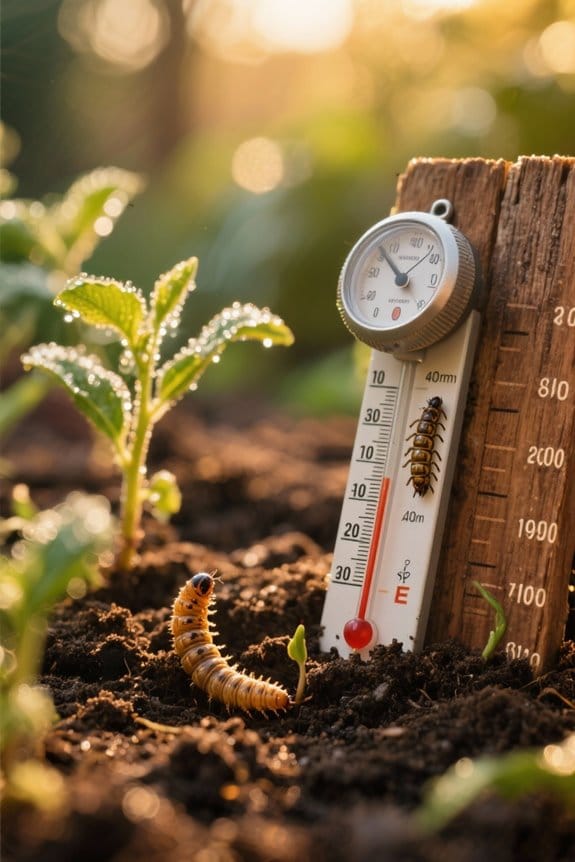
Temperature influences not just when pests appear, but also how they develop. Growing Degree Days (GDD) is a useful tool for estimating insect pests’ development stages. By measuring heat accumulation based on daily average temperatures, GDD helps farmers make smart management decisions. Remember, the formula is simple: take the daily maximum and minimum, add them, divide by two, and subtract the temperature threshold, typically set at 50°F for many pests. Weather data from local stations, like the Iowa Environmental Mesonet, provides the needed inputs to calculate GDD accurately. For example, the alfalfa weevil needs 190 GDD to start feeding! Utilizing beneficial insects, such as ladybugs and nematodes, reduces reliance on chemical pesticides and supports a balanced ecosystem. Armed with this knowledge, you can proactively protect your crops and keep those pesky bugs at bay.
Recommended Products
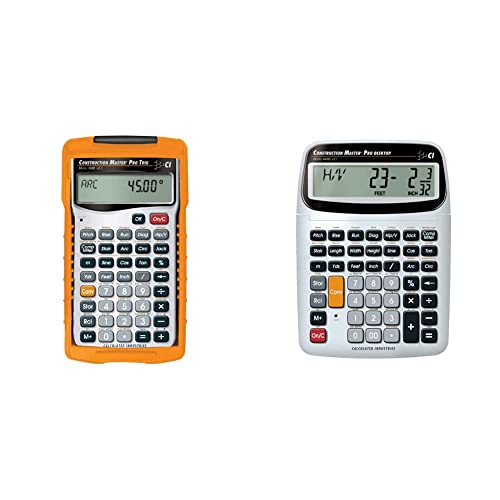
Product 1: SOLVE YOUR DIMENSIONAL MATH quickly and accurately with the award-winning CM Pro Trig construction calculator’s powerful built-in solutions for completing layouts; and full trig functions with sine, cosine, tangent, arcsine, arccosine and arctangent

Product 1: SOLVE YOUR DIMENSIONAL MATH quickly and accurately with the award-winning CM Pro Trig construction calculator’s powerful built-in solutions for completing layouts; and full trig functions with sine, cosine, tangent, arcsine, arccosine and arctangent

Construction Master ProCalculator & 2140 Construction Master Pro Workbook and Study Guide
Calculation Methods for GDD
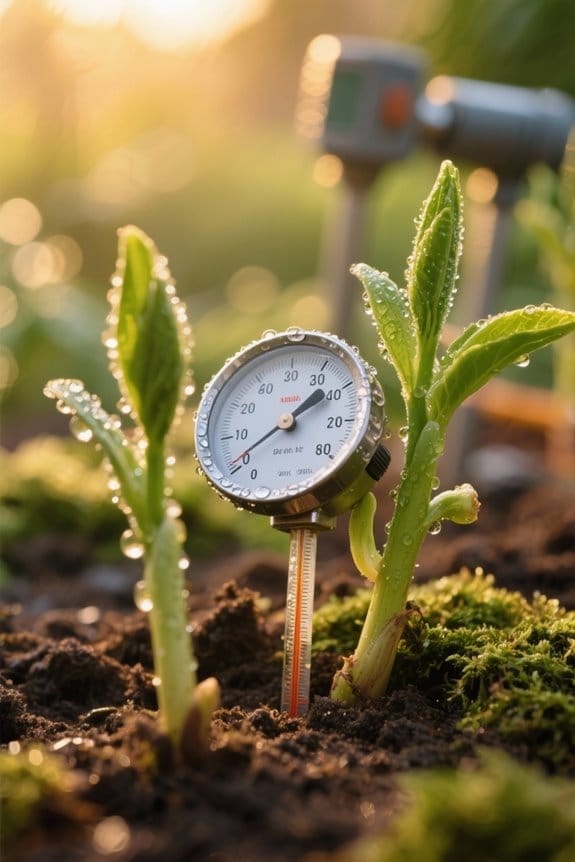
Calculating Growing Degree Days (GDD) can feel a bit like solving a puzzle, but don’t worry—it’s easier than it sounds! To calculate GDD, you use the formula: GDD = [(daily maximum temperature + daily minimum temperature) ÷ 2] – lower developmental threshold temperature. If the daily minimum drops below this threshold, simply use that threshold for your calculation. Accumulation only counts when the average temperature exceeds that threshold, so no negative values here! Many insects use a common lower threshold of 50°F, but some thrive even at 38°F or 43°F. Keep in mind that growth halts at an upper threshold of 86°F, meaning GDD accumulation stops here too. It’s all about understanding those temperature degrees! Utilizing organic pest control methods can help manage pests effectively without harming beneficial insects, ensuring a balanced ecosystem in your garden.
Regional Variations in GDD Accumulation
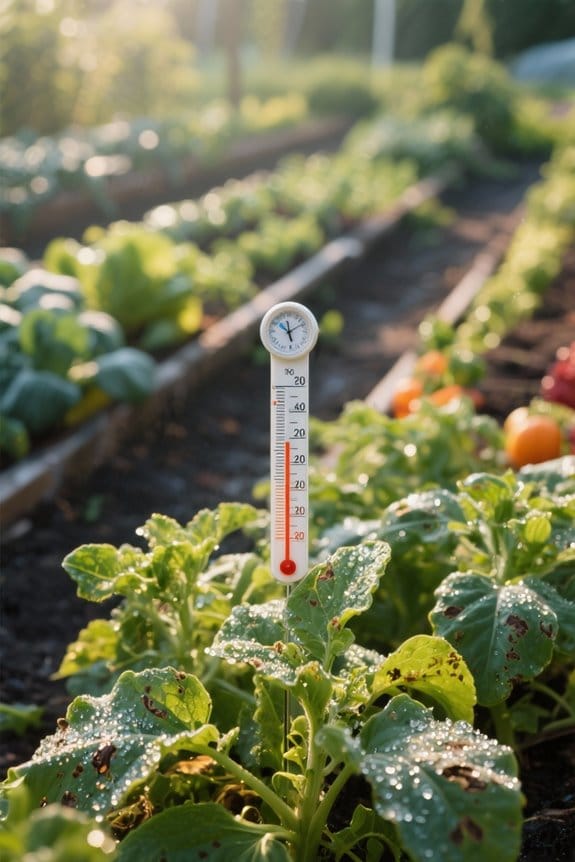
GDD accumulation can vary widely from one region to another, making local weather data more important than ever. For instance, weather stations can reveal that neighboring areas may accumulate GDD differently. A notable case occurred on April 11, 2011, when Oakland County recorded 25 GDD. This disparity in accumulation showcases how vital local climate data is for effective pest management. Annual variations in GDD can lead to a two-week gap in pest development timing between adjacent locations. Such differences highlight the importance of understanding temperature thresholds. By using accurate GDD calculations, you can reduce pesticide waste and align treatments with pest lifecycles. After all, a well-timed strategy is like waiting for the perfect moment to catch a fish! Beneficial insects like Green Lacewings and Ladybugs enhance garden health by targeting and controlling specific pests, which can complement the timing of pest management strategies based on GDD.
Application of GDD in Pest Management
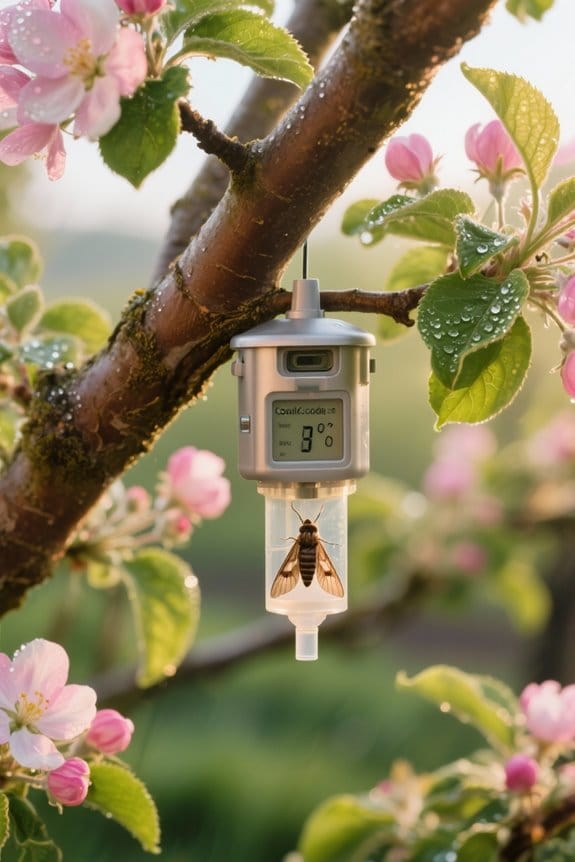
In pest management, effective timing can be the difference between a thriving crop and a devastated yield. Growing Degree Days (GDD) is an essential tool for ensuring that control measures are implemented at the right moment. By using accurate GDD calculations, farmers can track how temperature thresholds affect pests like the alfalfa weevil, which needs 190 GDD to start its tip feeding. It’s all about staying ahead, and localized data from sources like the Iowa Environmental Mesonet can make a big difference. Remember, weather variations can impact your region’s GDD accumulation, so keep an eye on the forecast. With timely action based on GDD predictions, farmers can protect their crops and avoid the frustration of losing a precious harvest to unwelcome pests. An important consideration in pest management is the use of organic pest control solutions, which are eco-friendly and reduce chemical exposure for plants, pets, and humans.
Recommended Products

SUPER CONCENTRATE MAKES 1,000 GALLONS - Earth's Ally 3 in 1 Plant Spray Super Concentrate creates 1,000 gallons of multi-purpose pest and fungus spray that works as an insecticide, miticide and fungicide. The formula effectively controls insects and common plant diseases with a synergistic blend of botanical oils.

𝐏𝐨𝐰𝐞𝐫𝐟𝐮𝐥, 𝐀𝐥𝐥-𝐏𝐮𝐫𝐩𝐨𝐬𝐞 𝐏𝐞𝐬𝐭 𝐂𝐨𝐧𝐭𝐫𝐨𝐥: Eliminator Insecticide and Fungicide Concentrate tough away and controls mildew, fungus, mold, aphids, spider mites, whiteflies, fungus gnats, thrips, mealybugs, flies, and more – ideal for gardens, crops, greenhouses, and residential spaces.

EFFECTIVE SPIDER MITE, POWDERY MILDEW & PLANT DISEASE CONTROL – Natural miticide and spider mite killer effective against two-spotted spider mites, broad mites, russet mites, whiteflies, aphids, powdery mildew, and downy mildew on vegetables, flowers, houseplants, indoor plants, ornamentals, and garden crops.
Key Pests and Their GDD Requirements
Managing pests effectively is akin to playing a game of chess: strategic timing can mean victory for your crops. Understanding growing degree days (GDD) is key to this strategy. For instance, the alfalfa weevil requires about 190 GDD from January 1, indicating when to scout and act. On the other hand, the Eastern Tent Caterpillar springs into action around 100 GDD, signaling the perfect time for pest management interventions. As the season progresses, the white pine weevil becomes active at approximately 300 GDD, demanding timely action to evade crop damage. Knowing these temperature thresholds helps farmers manage pests like the Balsam Twig Aphid, which has a lower threshold of around 38°F, making timely scouting essential for effective control. Understanding the importance of pest control for a thriving garden ensures that your crops remain healthy and productive while managing infestations efficiently.
Resources for GDD Calculation and Monitoring
When it comes to tracking growing degree days, having reliable resources is essential for farmers. The MSU’s Enviro-weather website offers valuable GDD calculations from multiple weather stations across Michigan. These local weather stations provide specific GDD data that can change greatly based on region, helping farmers predict pest activity accurately. Farmers can also utilize historical data to anticipate pest behavior linked to past temperature trends. Understanding GDD thresholds for various insect pests is available online, making timing for pesticide application more effective. Continuous tracking of average daily GDD accumulation is key for integrated pest management (IPM) practices. Remember, when it comes to pests, being proactive beats being reactive! Additionally, incorporating organic gardening standards into pest management can enhance sustainability and reduce chemical exposure for both gardeners and the environment.
Recommended Products

USER-FRIENDLY DISPLAY – Natural Textbook Display℠ shows expressions and results exactly as they appear in textbooks, simplifying writing and interpreting complex math.

SOLVE ALL YOUR DIMENSIONAL MATH quickly and accurately with the award-winning CM Pro construction calculator’s powerful built-in solutions for completing layouts, plans, bids, estimates and more, directly in the building units you prefer

BOOST EARLY MATH SKILLS - Help students practice addition, subtraction, multiplication, and division with easy-to-use calculators designed for PreK and up.
Impact of Weather on Pest Activity
Weather has a tremendous impact on pest activity, shaping when and how quickly these critters emerge. Cold-blooded insects depend on temperatures to develop, making seasonal changes critical to pest behavior. Most pests require a base temperature of around 50°F to start growing. This is where accumulated Growing Degree Days (GDD) come into play, offering a dynamic way to track their development over mere calendar dates. Local weather stations help pinpoint GDD buildup, guiding integrated pest management strategies effectively. By observing seasonal temperature changes, you can stay a step ahead, tweaking your pest control actions to match nature’s rhythm. Bug Zappers Overview highlights the effectiveness of devices like bug zappers in managing pest populations by attracting and eliminating insects using UV light and high voltage grids, providing a chemical-free solution. It’s all about being proactive—after all, a well-prepared gardener is a happy gardener!
Frequently Asked Questions
What Is the Threshold Temperature for Insects?
The threshold temperature for insects governs insect growth, regulates pest survival, and shapes pest populations. With thermal impact changes from climate shifts and evolving weather patterns, ecological balance becomes increasingly fragile, necessitating careful monitoring and adaptive pest management strategies.
What Is the Developmental Temperature Threshold?
The developmental temperature threshold influences the pest life cycle by impacting metabolic processes and seasonal patterns. Variations in these thresholds reveal ecological interactions and climate effects, highlighting the importance of understanding temperature’s role in insect development rates.
What Is a Threshold Level for Pest Control?
A threshold level for pest control involves understanding pest population dynamics and environmental factors, enabling integrated pest management. This includes timing chemical applications, employing biological control methods, and habitat modification techniques for nuisance pest species and resistance strategies.
What Is the Critical Temperature Threshold?
In the delicate dance of ecosystems, the critical temperature threshold defines limits for pests. Climate change exacerbates temperature fluctuations, influencing pest migration and resistance, ultimately threatening agricultural impact and crop yield, necessitating integrated pest management strategies.